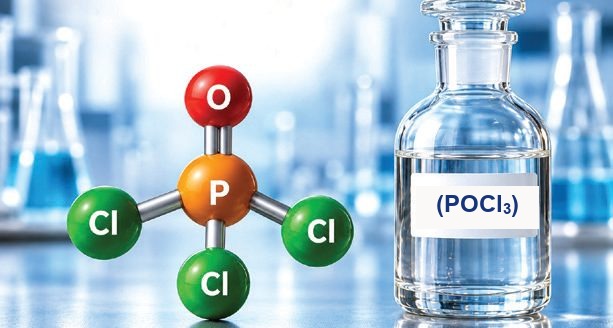
Semiconductors and solar cells are built on silicon that has been deliberately modified with tiny amounts of other elements. This process, called doping, gives silicon the electrical behaviour that devices need. Phosphorus is the usual choice for creating n-type regions, and phosphorus oxychloride (POCl3) is one of the most common ways to deliver it.
What doping does
Pure silicon conducts poorly. Adding phosphorus atoms supplies extra electrons and creates an n-type layer. Combined with a p-type layer, this forms the junctions that integrated circuits, memory chips, power devices, sensors and solar cells depend on.
How POCl3 is used
In a typical diffusion step, POCl3 vapour is carried into a heated furnace together with oxygen and an inert gas. It reacts at the silicon surface to form a thin phosphorus-rich glass layer. At high temperature, phosphorus then diffuses from that layer into the silicon to the depth and concentration the design requires. The glass is removed afterwards. The method is well established and scales well, which is why it is used widely in silicon solar-cell production and in several device-fabrication steps.
Why purity is so important
Because only trace amounts of dopant are involved, anything else in the source chemical can matter. Metallic impurities can degrade carrier lifetime and reduce device performance, and excess moisture reacts with POCl3 to form acids that affect process control and equipment. Semiconductor users therefore specify ultra-high-purity, electronic-grade POCl3, commonly 99.999% or higher, with very low metals and moisture, to protect reliability and yield.
Purity is made, not found
Reaching that level takes careful distillation, clean handling, dry storage and good analytical control. It also takes consistency from batch to batch, because a process that is qualified on one lot must behave the same on the next.
A supply-chain opportunity for India
India's semiconductor ambitions under the India Semiconductor Mission are creating demand for electronic-grade process chemicals, many of which are imported today. A local source of high-purity POCl3 shortens lead times, reduces inventory risk and makes technical collaboration easier.
Where Shreeyansh Labs fits
Shreeyansh Labs manufactures POCl3 at its Telangana facility and is equipped with a suitable distillation reactor to produce high-purity material. If you are qualifying a domestic POCl3 supplier, we welcome a technical discussion about your specification. Request a call back or send us your requirements.
Shreeyansh Labs manufactures phosphorus chlorides at Kucharam, Medak, Telangana. Ask for a quotation and technical documents.